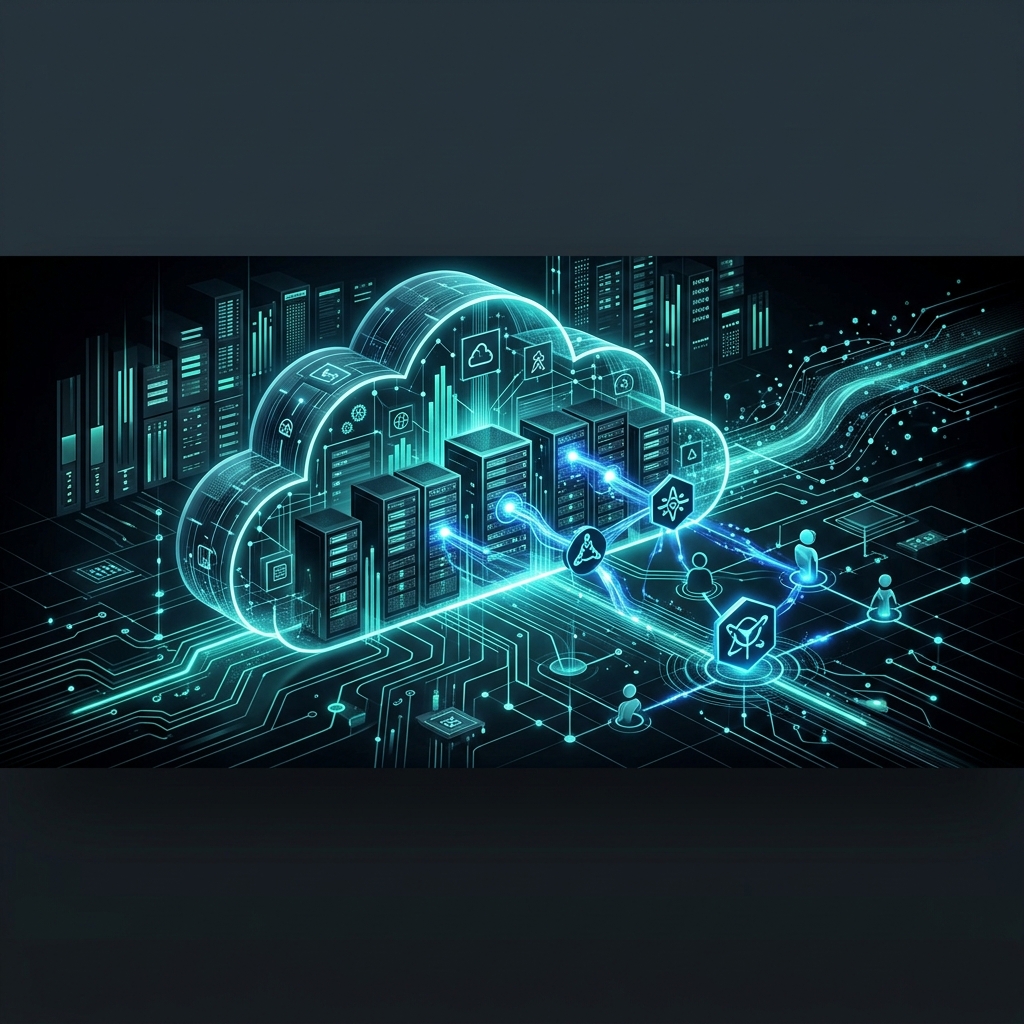
In a modern enterprise IT architecture, an AI agent is more than a simple chatbot; it is a system designed to interpret user inputs, evaluate context, access databases, call APIs, and execute actions to support specific business workflows. Deploying these agents in the cloud allows organizations to move beyond isolated sandboxes and build scalable, secure, and production-ready cognitive tools. However, moving an agent from local development to a cloud-native environment requires shifting focus from the underlying model to the broader architecture that supports it.
Why Deploy AI Agents in the Cloud?
Cloud platforms are the natural choice for hosting enterprise AI agents, primarily because they minimize infrastructure complexity. Leveraging managed AI and model-hosting services allows engineering teams to bypass the heavy lifting of GPU provisioning and low-level optimization, freeing them to focus on business logic.
Furthermore, cloud environments provide seamless, low-latency integration with essential resources—such as managed databases, vector storage, identity management, and messaging queues. This connectivity makes it straightforward to scale agentic workloads horizontally as demand fluctuates. Ultimately, the cloud offers a controlled environment for rapid experimentation, allowing teams to iterate on agent designs while maintaining complete operational and cost visibility.
What Makes a Deployment Successful?
A successful deployment relies on treating the AI agent as one component of a larger software system. The effectiveness of an agent is heavily dependent on the quality and structure of its environment:
- Defined Scope: Clear boundaries around what the agent is authorized to do and which APIs it can access.
- Contextual Data Access: Connecting the agent to clean, structured data sources (e.g., via Retrieval-Augmented Generation) so its outputs remain accurate and relevant.
- Granular Identity & Permissions: Assigning distinct IAM roles to the agent, ensuring it operates strictly within its designated security perimeter and cannot access unauthorized data.
- Observability: Implementing detailed logging and tracing to monitor decision-making paths, token usage, and latency.
- Human-in-the-Loop (HITL): Designing validation steps for high-risk or external-facing actions, ensuring human oversight before execution.
Common Cloud Deployment Patterns
Depending on the business case, enterprise cloud architectures generally utilize one of several standard patterns for agent deployment:
- RAG-Driven Knowledge Assistants: Agents connected to secure vector databases and document stores, enabling employees to query internal knowledge bases with precise, source-backed answers.
- Operations & Support Copilots: Integration with ticketing systems and communication platforms (like Slack or Teams) to assist engineers in querying system statuses, searching incident history, or drafting responses.
- Event-Driven Workflow Helpers: Agents triggered by specific system events or messages, running background tasks such as parsing incoming documents, extracting metadata, and updating databases.
- API-Enabled Orchestrators: Agents exposed as microservices that coordinate complex tasks across multiple cloud APIs, acting as intelligent middleware.
What to Avoid
To ensure reliability, teams should be aware of several common anti-patterns during cloud deployment:
- Model-Centric Thinking: Treating the choice of LLM as the sole factor in success, while ignoring input sanitization, error handling, and runtime guardrails.
- Permissions Over-Privileging: Granting agents broad administrative access instead of applying the principle of least privilege, creating potential security vulnerabilities.
- Hype-Driven Projects: Launching agent initiatives without a clear business use case or success metrics, resulting in orphaned projects.
- Lack of Operational Ownership: Deploying agents without a clear monitoring dashboard, alert thresholds, or a dedicated team to maintain integration points and dependencies.
Building for the Long Term
Deploying AI agents in the cloud offers significant opportunities for workflow automation and operational efficiency, but only when built on a foundation of architectural discipline. By integrating agents into secure, observable, and well-designed cloud systems, organizations can transition from experimental technology to reliable digital assistants that deliver consistent business value.